

What are bridging programs for newcomers to Canada?
Bridging programs are designed to support internationally trained professionals in their pursuit of meaningful employment in the local job market.
These programs offer newcomers an opportunity to bridge the gap between their existing skills and experience and the requirements of the Canadian work culture. To appreciate the benefits of a bridging program, imagine yourself as a brain library with shelves representing different periods of your job and personal development. When you relocate, you notice that your brain library has suddenly gone empty. Thus, a bridging program fills gaps in your education, training, and work experience adjusting to a new language, culture, and trade. It respects their expertise while helping them adapt to new rules and regulations.
What does bridging mean in education, and what is the difference with other programs of colleges or universities?
Bridging programs are designed to fill the unique gaps most immigrant professionals have while respecting and acknowledging the existing professional knowledge and experience.
These programs are shorter, more intensive, and much cheaper than other alternatives, because the government subsidizes them, and they are not made to make a profit from participants.
On the other hand, academic programs are customized to local students. Purely academic programs are intended to construct a new shelf at the top of your library, not to fill empty places on current shelves. MNLCT‘s bridge training programs acknowledge that students already have professional expertise and that what they need is a program to assist them fill the gaps, not one to teach them what they already know.
How does the bridging program work in Ontario?
The Ontario Bridge Training Program (OBTP) is a vital initiative that supports internationally trained immigrants (ITIs) in their efforts to secure employment in their field or a related field while ensuring their existing skills and education are not duplicated.
The program is designed for regulated and non-regulated high-skill jobs, offering ITIs extensive help as they handle the challenging process of obtaining work in their sector in Ontario. Universities and public colleges, occupational regulating authorities, community agencies, employer associations, and for-profit organizations are examples of service providers.
What is the Ontario Bridge Training Program and how is it helping internationally trained professionals find jobs in their field?
The Ontario Bridge Training Program (OBTP) aims to connect internationally trained professionals with in-demand jobs in their communities through specialized programs that help newcomers match and enhance their skills and experience to meet the needs of local employers. The program has committed significant resources over a period of three years to achieve this goal.
What is MNLCT and how is it helping newcomer professionals find meaningful employment in the Canadian labour market?
We are an organization that provides bridging programs for newcomer professionals, offering them an understanding of Canadian work culture, further training and education, career coaching, and networking opportunities to help them develop a career plan. Through partnerships with employers, professional associations, universities, and regulatory institutions, MNLCT helps newcomers secure a position that matches their education, credentials, and experience.
With a high social return on investment, MNLCT’s bridging programs have historically resulted in more than 85% of graduates being employed in their chosen fields, with improved professional networks, subject matter expertise, communication skills, and confidence in applying for jobs and attending interviews.

What bridging programs does MNLCT offer?
MNCLT offers our programs online, and you can participate from any city in Ontario.
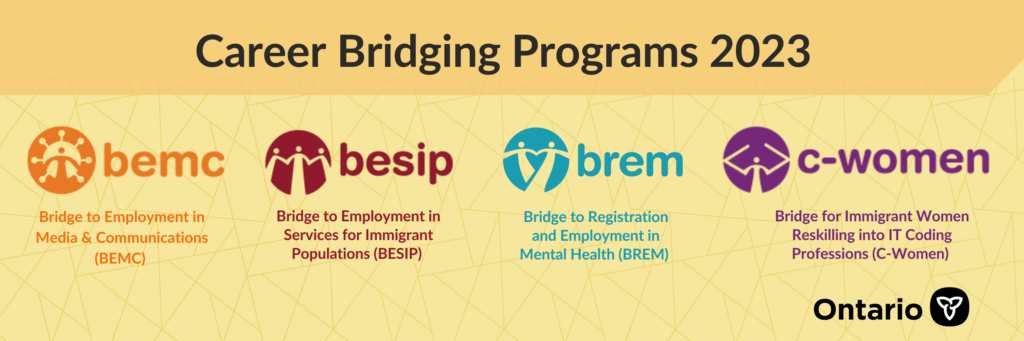
- Bridge to Employment in Media, Marketing, and Communications (BEMC) Immigrants with a background in Communication & Public Relations, Digital Marketing, Entrepreneurship, Videography, Broadcasting, Social Media, and Journalism are encouraged to apply.
- Bridge to Employment in Services for Immigrant Populations (BESIP) It is an option that provides internationally educated professionals with entry to a wide variety of positions in human/social/community services.
- Bridge to Registration and Employment in Mental Health (BREM) supports immigrant professionals of the mental healthcare sector in obtaining licensing and working in their fields, including counseling, social work, psychiatry, nursing, psychotherapy, and divinity counselling.
- Bridge for Immigrant Women Reskilling into IT Coding Professions (C-Women). This Program helps women and non-binary immigrants with various backgrounds access and succeed in high-paying IT careers, regardless of prior education or experience.
Who is eligible for the bridge training programs?
To qualify for the MNLCT bridge training programs:
- Be an Ontario resident over 18 with foreign postsecondary education
- English ability at or above CLB Level 7
- Some programs require job experience in your field.
- Legal immigration status as refugee claimants, permanent residents, and naturalized Canadian citizens.
- Computer literacy: strong computer, Office suite, video conferencing
- Personal Readiness: highly motivated and able to commit.
- International students or temporary foreign employees are not eligible.

What exactly is CLB?
CLB is an abbreviation for Canadian Language Benchmarks, which is a descriptive measure of English language proficiency. It establishes a single Canadian framework for characterizing and measuring English communication for instructional and other purposes, enabling a consistent foundation for the development of programs, curriculum, resources, and assessment tools throughout Canada.